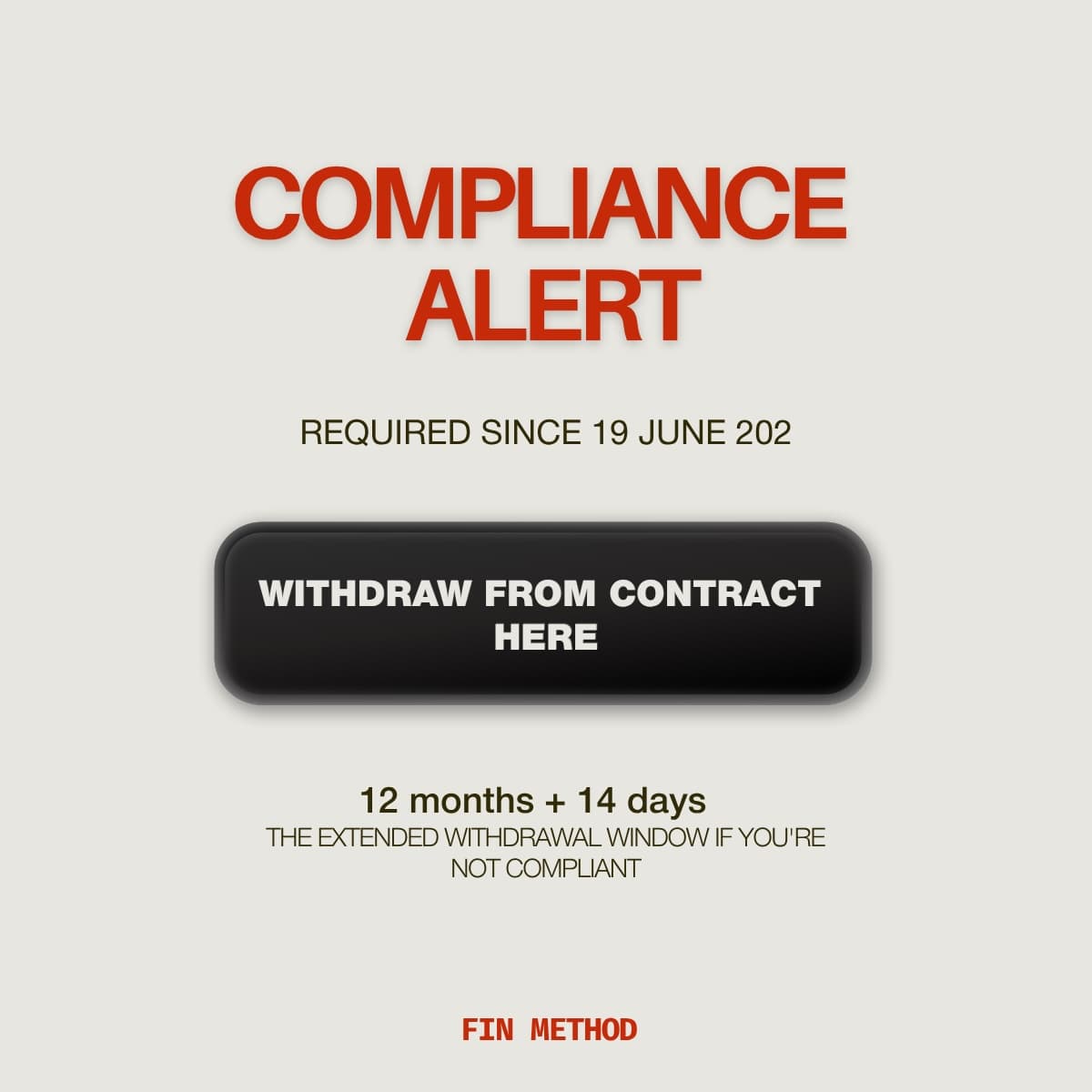
On June 19, 2026, a piece of EU regulation quietly reshaped online retention strategy for every D2C brand selling into Europe.
If your Shopify store sold to EU customers before that date and doesn't now have a compliant Withdrawal Button, three things are true:
- You're technically non-compliant with EU Directive 2023/2673
- Your customers' 14-day right of withdrawal has been legally extended to 12 months and 14 days for any order placed while you were non-compliant
- Local EU consumer authorities can hit you with administrative penalties, which in Italy alone can reach 4% of turnover
Most UK D2C brands scaling into Europe haven't updated their checkout or post-purchase flows. Many have never heard of the Withdrawal Button. Some know about it and assumed it doesn't apply because their business is UK-based. It applies. Any online store targeting EU buyers — regardless of where the business is registered — falls under this directive.
This isn't a "you should really get compliant" post. It's an "if you're not compliant yet, here's what you're actually exposed to, and how to fix it in the next 30 days" post. Plus the retention strategy reframe that most brands are missing.
What the directive actually requires
EU Directive 2023/2673 amends the 2011 Consumer Rights Directive. Its stated purpose: make cancelling an online purchase as easy as completing it.
The specific mechanics are legally prescribed and not open to creative interpretation:
A prominent Withdrawal Button on your store. Visible without login. Accessible from any page. Cannot require account registration or app download to access.
Two-step withdrawal process. First step labeled "Withdraw from contract here" (or local-language equivalent). Second step is a confirmation page labeled "Confirm withdrawal." The two-step structure is mandatory to prevent accidental cancellations on mobile.
Customer identifies the order. On the confirmation page, the customer enters or confirms their name, contact details, and the specific order or contract they're withdrawing from. Line-item partial withdrawal is optional but permitted.
Timestamped acknowledgement. After the customer confirms withdrawal, you must send an automated confirmation email on a "durable medium" (their term). This proves the withdrawal was received and creates a paper trail for both parties.
Applies to distance sales. Any order placed online, via app, or through remote channels. In-person retail sales are exempt.
Exceptions exist — perishables, custom-made products, unsealed hygiene items, date-specific bookings — but the exceptions are narrow. For standard D2C ecommerce (apparel, beauty, home, wellness, electronics), the directive applies fully.
The 14-day withdrawal period itself isn't new. What's new is the mandatory online button that lets customers exercise the right without contacting you, filling out forms, or logging into anything.
What non-compliance actually costs you
Two things happen if your store isn't compliant.
The 14-day period extends to 12 months and 14 days.
This is the most-underestimated consequence. If a customer places an order today and your store has no compliant Withdrawal Button, that customer's right of withdrawal doesn't expire in 14 days. It extends automatically to 12 months and 14 days from delivery.
Think about what that means operationally. Any order in the last year could theoretically be cancelled, with a full refund required, and your ability to recover the product is limited (you'd need to arrange return shipping). Every order in your non-compliant window becomes a contingent liability sitting on your balance sheet for a year.
Administrative penalties from national consumer authorities.
Each EU member state sets its own penalty framework. Italy has been most explicit: the AGCM (Italy's competition and consumer authority) has direct sanctioning powers over e-commerce interfaces and can impose fines up to 4% of turnover in Italy. Germany, France, and Spain have similar frameworks though the specific penalty structures vary.
For a mid-size UK D2C brand doing €500k/year in EU sales, that penalty exposure alone is a genuine £20k+ risk. Cheap risk to eliminate. Expensive risk to ignore.
Why Shopify doesn't solve this for you natively
The frustrating operational reality: Shopify has no native Withdrawal Button feature. Not as of the June 19, 2026 deadline. Not as of when you're reading this.
Shopify's admin-side cancel and refund tools are for merchant-initiated cancellations. Those don't meet the directive's requirements. The directive requires a customer-facing, self-service, two-step process with automatic confirmation email. That's a completely separate feature.
Your three real options for building compliance:
Option A — Install a dedicated Withdrawal Button app. Multiple apps have launched in 2026 specifically for this. The EU Withdrawal Button app (free EARLYBIRD tier), Revize, IFG Returns & Withdrawals, and others. Fastest path — install, configure, live within a few hours. Costs range from free to £30/month depending on features.
Option B — Custom build using Shopify Flow + a public page. For brands with development resources or Shopify Plus, a custom implementation gives more control over branding and workflow. Takes 3-5 days of developer time. Costs £750-£2,500 depending on complexity and integration requirements.
Option C — Do nothing. The path most brands are on, whether by conscious decision or by not knowing. Every order placed while non-compliant carries the 12 months and 14 days extended withdrawal risk. Every day you delay, the risk pool grows.
For most UK D2C brands, Option A is the honest answer — fast, cheap, meets the legal minimum. Option B makes sense when the Withdrawal Button is part of a broader post-purchase flow you're rebuilding anyway.
The retention reframe most brands are missing
Here's where the strategic thinking gets interesting.
The default emotional response to the Withdrawal Button is defensive: we're being forced to make cancellations easier, which will hurt retention.
That framing is wrong.
The Withdrawal Button doesn't create cancellation intent. It surfaces cancellation intent that was already there. Customers who wanted to cancel and couldn't find a way used to email support, complain publicly, dispute their card charge, or leave a 1-star review. Now they click a button.
The strategic implication: easy cancellation is a diagnostic tool for genuine product-market fit.
Brands with strong PMF see modest withdrawal rates and get clean data on why customers cancel. Brands with weak PMF see their withdrawal rate expose the churn that was previously hidden in support-inbox chaos.
The post-Withdrawal-Button era rewards brands that:
1. Get honest data on cancellation reasons.
The two-step confirmation page is a legally mandated capture point. Some brands use it as a friction point (bad idea, non-compliant). Others use it as a genuine data capture opportunity — asking one clean question about why the customer is withdrawing. That single question, aggregated across withdrawals, becomes the highest-quality retention signal you've ever collected.
2. Rethink post-purchase communication to preempt withdrawal.
If your typical withdrawal happens 8-11 days after delivery, your post-purchase flow needs to solve the customer's problem within the first 7 days. That's a completely different flow from "here's a discount code for your next order." It's proactive product education, sizing guidance, use-case content, or check-in emails.
Brands that shift budget from "chase the next sale" to "protect the current one" see meaningful improvements in the ratio of orders retained vs orders withdrawn. The Withdrawal Button just makes that ratio visible for the first time.
3. Segment customers who withdraw vs customers who don't.
The customer who clicks Withdraw from Contract is telling you exactly who's at churn risk in your database. Your ability to build a distinct segment around them, exclude them from win-back campaigns, and target them with retention-specific content is a real strategic advantage.
Most brands will treat every customer the same after purchase. The brands that operationalise the Withdrawal Button data will build sharper retention economics than their competitors.
The 5-step compliance and retention plan
If you're a UK D2C brand selling into the EU on Shopify and you're not yet compliant, this is the operational plan for the next 30 days.
Step 1 — Install a Withdrawal Button solution (within 7 days)
Don't overthink this. Install one of the compliant apps. Configure with the mandatory two-step flow and confirmation email. Verify the button appears on your storefront, accessible without login.
The apps handle the legal minimum. You can layer strategic thinking on top. But get the compliance baseline live first.
Step 2 — Add withdrawal reason capture (within 14 days)
On the confirmation page (second step), add one clean question: "What's the main reason you're withdrawing?" Give 5-6 preset options (product not as expected, sizing issue, arrived damaged, changed mind, found better alternative, other) plus a free-text field.
Do not add friction here. Do not require the customer to explain themselves. Do not attempt to talk them out of it on this page. The question is diagnostic, not defensive. Every attempt to save the sale at this step is technically a compliance violation.
Step 3 — Update your post-purchase email flow (within 21 days)
Analyse the timing of your typical withdrawals. Most happen between day 7 and day 12 post-delivery.
Restructure your post-purchase email sequence to deliver value in that window:
- Day 2: order arrival confirmation + product care/use tips
- Day 4: expected experience and quality indicators
- Day 7: check-in email with a link to support if anything isn't right
- Day 10: usage tips, community features, care instructions
- Day 14: transition into brand storytelling and next-purchase content
The goal is to make sure a customer's day 8 doubt gets resolved by your day 7 email, before they reach for the Withdrawal Button.
Step 4 — Build a withdrawal-cohort dashboard (within 28 days)
Create a simple dashboard tracking:
- Withdrawal rate: withdrawn orders as % of total orders
- Withdrawal timing: distribution of days from delivery to withdrawal
- Withdrawal reasons: aggregated from the diagnostic question
- Product-level withdrawal rate: which SKUs get withdrawn most
Review weekly. Any SKU with a withdrawal rate above 4-5% is telling you something specific about the product or its listing that needs addressing.
Step 5 — Feed withdrawal data back into product and listing decisions (ongoing)
Withdrawal reasons are the highest-signal customer feedback you'll ever collect. Every "sizing issue" withdrawal is telling you the product page needs a size guide. Every "not as expected" is telling you the product photography is misleading. Every "found better alternative" is telling you your competitive positioning has a problem.
The brands that operationalise this feedback loop will spend 2026-2027 quietly improving product-market fit while their competitors keep firefighting individual complaints in the support inbox.
Free downloadable checklist — verify your compliance in 10 minutes
I've built a free 1-page compliance checklist you can print and work through with your team.
The Shopify EU Withdrawal Button Compliance Checklist (PDF) — a print-friendly 6-point verification covering the specific requirements from EU Directive 2023/2673. Each check has tick boxes for ✓ (compliant) and ✗ (non-compliant). Below the checks, a decision tree shows exactly what to do next for each common failure mode.
Free. No email required. Print it, work through it with your team, escalate any ✗ answers.
The adjacent regulations (briefly)
Two related EU regulations are worth flagging as adjacent compliance challenges — but they're separate battles requiring separate planning.
PPWR (Packaging and Packaging Waste Regulation) requires specific packaging disclosures, recyclability marking, and material composition transparency. Deadlines vary by member state, with most requirements phased in through 2026-2028. If you ship physical products into the EU, PPWR compliance is on your roadmap whether you know it or not.
Green Claims Directive tightens rules around environmental marketing claims. "Eco-friendly," "sustainable," "carbon neutral" — any of these on your Shopify product pages now require specific substantiation and disclosure. Enforcement is escalating throughout 2026.
Both are worth their own operational review. Neither is what the Withdrawal Button is. Don't conflate them into one compliance project — you'll under-serve all three.
What this means for your 2026 planning
The Withdrawal Button is the regulatory event that reshapes UK D2C retention strategy for the next 3-5 years.
Old model: make cancellation difficult. Hope customers give up. Book the revenue.
New model: make cancellation easy. Understand why customers leave. Build product and communication around the truth.
The brands that get this right treat the Withdrawal Button not as a compliance chore but as the best customer feedback mechanism they've ever installed. Every click is a data point they didn't have before.
The brands that get it wrong treat it as an existential threat to their revenue and fight the intent of the regulation with legally-questionable friction. Those brands will spend 2026-2027 defending compliance actions, losing extended-withdrawal disputes, and watching their retention data get progressively worse as customers who couldn't cancel find other ways to leave (chargebacks, one-star reviews, social media complaints).
Install the button. Capture the reasons. Feed the data back into the product. Fix the retention problem at the source.
Or spend the year explaining to Italian consumer authorities why your English-language store doesn't need to comply with a directive that applies to any store selling to EU buyers.
Before you engage anyone, download the compliance checklist and work through it with your team. Ten minutes of verification tells you exactly which requirements you're meeting and which need fixing.
If your Shopify store needs the underlying post-purchase flow rebuilt to work with (not against) EU consumer regulation, Fin Method's Shopify Content & UX (£550) rebuilds one product or collection page for clarity, conversion, and post-purchase alignment. For a broader diagnostic across your Shopify funnel including checkout and withdrawal-flow touchpoints, UX & Funnel Optimisation (£750) covers the top six prioritised UX changes across your funnel with expected impact mapped. And if you want to turn withdrawal data into product decisions, Return Patterns Analysis (£550) covers return data across up to ten SKUs with root causes identified. Fixed price. No retainers.