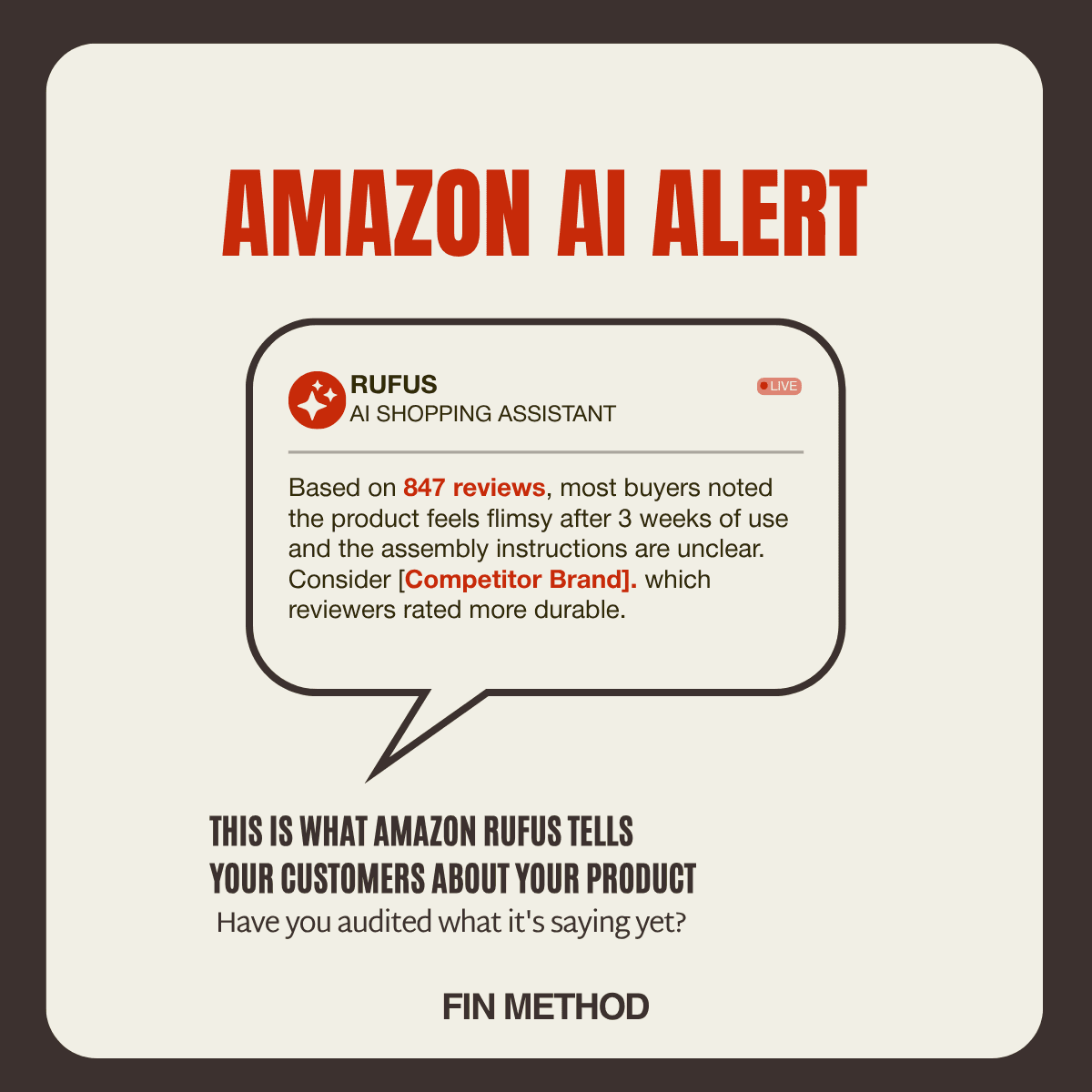
Rufus doesn't read your listing the way a customer does.
It scans 500 reviews, picks out your three biggest flaws, and — if you haven't given it better material to work with — tells buyers exactly why not to buy your product.
That last part isn't a threat. It's a description of what's happening on your listings right now, whether you've noticed or not.
Amazon's AI shopping assistant has 250 million active users as of Q3 2025. Shoppers who engage with it are 60% more likely to complete a purchase. Both numbers are Amazon's own, from Andy Jassy's earnings call. It's not a beta. It's not a side experiment. It's the layer sitting on top of your product detail page every time a customer opens your listing on the mobile app.
And most sellers still think they're optimising for A9.
Here's what Rufus is actually doing on your listing
Open the Amazon app. Go to any product page. See that little AI-generated summary at the top of the screen — Why you might like this? That's Rufus.
It generated that summary by reading your bullets, your Q&A, your A+ content, the text on your images, and your reviews. It synthesised them into a paragraph. And it did it in about 200 milliseconds while the customer was still deciding whether to scroll.
That paragraph is now the first thing your buyer reads about your product.
If your listing has clean structured data, useful bullets, and a well-managed Q&A section, Rufus writes something helpful. Something like "Made from 18/8 stainless steel, dishwasher safe, and rated for hot beverages. Customers particularly praise its leak-proof seal for daily commuting."
If your listing is a mess — keyword-stuffed title, three unanswered Q&As, and a cluster of reviews complaining about a cracked lid — Rufus writes what it can from what you gave it. Which is: "Some customers report leaking issues after several weeks of use. Consider reviewing recent reviews before purchasing."
Same product. Same 4.2-star average. Completely different first impression.
You didn't write the second version. You didn't approve it. You can't edit it. And it's what your buyer is reading right now.
Why this is happening to sellers who "did everything right"
Here's the uncomfortable part. Rufus doesn't reward the listings that ranked highest on A9. It rewards the listings that answered questions clearly.
Those are two completely different disciplines.
A9 rewarded keyword relevance and sales velocity. You could win at A9 with a title like "Premium Stainless Steel Water Bottle 32oz Insulated Vacuum Flask Sports Gym Fitness Reusable BPA Free Leak Proof Wide Mouth" and call it a day.
Rufus reads that title and sees noise. It's looking for factual, structured, answerable content — bullets written as answers to questions, filled-in backend attributes, clear image text it can read via OCR, and a Q&A section that pre-answers what shoppers actually ask.
If your listing was optimised for 2019 Amazon SEO, it's probably underperforming with Rufus right now. Not because you did anything wrong. Because the game changed and nobody sent you the memo.
What Rufus reads, in the order it trusts it
Based on Amazon's own technical disclosures and consistent seller testing across 2025-2026:
1. Backend structured attributes. The single most under-optimised surface in Amazon selling. Rufus prefers verified structured data over marketing copy every time. If your "Oven Safe Temperature" field is blank but your bullets say "oven safe to 500F," Rufus doesn't trust the bullet as much as it would trust the field. Every empty attribute field is a hole in what Rufus can confidently say about your product.
Filling in every applicable attribute field is 15-30 minutes per ASIN. It's the highest-leverage Rufus optimisation almost nobody is doing yet.
2. Q&A section. Rufus pulls answers from your customer Q&A more than almost any other source. An answered question is a pre-fabricated Rufus response waiting to be served. An unanswered one is an opening for Rufus to reach for review data instead.
3. Reviews. This is the one that's killing you. Rufus treats reviews as ground truth — user-generated content that outweighs anything you say about yourself. You cannot edit reviews. But you can engineer around them. That's most of what this post is about.
4. Bullets and title. Still important, but the rules have flipped. Bullets need to read as answers to implicit questions, not lists of features. More on this in a minute.
5. A+ Content. Longer-form context. Comparison charts, use cases, technical specs. Rufus reads all of it.
6. Product images (via OCR). Yes, actually. Rufus reads the text on your images. Overlay text saying "DISHWASHER SAFE — TOP RACK" is a Rufus signal. A beautiful lifestyle shot with no readable text is not.
The single most expensive mistake most sellers are making
Your best-converting bullet doesn't matter if Rufus is quoting your worst review.
Let me show you what this looks like in practice.
You sell a mid-priced product. 4.4 stars. Decent volume. Roughly 8% of your reviews mention that "assembly is difficult." Your bullets don't address it. Your A+ content doesn't address it. There's one abandoned Q&A about it from 2023 with no response.
A shopper on the mobile app taps Rufus and asks: "Is this easy to assemble?"
Rufus reads the reviews. Sees the pattern. Answers: "Some customers have reported that assembly can be challenging. The instructions may be unclear for first-time users."
Not one word of that came from you. All of it came from a review cluster you never addressed.
That shopper leaves. Doesn't buy. Might buy from your competitor whose listing does address assembly time explicitly. You don't know it happened. You don't see a click. You just see conversion drop and blame the algorithm.
You could have prevented all of it with one bullet that reads: "Assembly takes 15 minutes with the included Allen key. Two-person assembly recommended for the base panel. QR code inside the box links to a step-by-step video."
Because Rufus prioritises structured product truth from your listing before falling back to review sentiment, giving it a factual answer routes it away from the review complaint. You're not lying. You're not hiding anything. You're just making sure Rufus has your version of the story before it reaches for the customers'.
This is what "AI answerability" means. Not a marketing term. A specific, measurable practice.
The 5-step Rufus audit workflow
Do this on your top 10 ASINs first. Then work your way down the catalogue.
Step 1 — Read your critical reviews and find the complaint clusters
Open your listing. Sort reviews by "most recent." Read the last 30-50 two-star and three-star reviews. Ignore one-star for now — those are usually shipping and logistics, which Rufus discounts.
Write down every complaint that shows up three or more times. The usual suspects:
- "Runs small" / "sizing is off"
- "Assembly is difficult"
- "Battery dies faster than advertised"
- "Smaller than I expected"
- "Instructions unclear"
- "Doesn't fit [common accessory]"
These are your Rufus attack surfaces. Every question a shopper asks that maps to one of these, Rufus will answer using the reviews if you haven't given it better material.
If your best-selling product has three complaint clusters, that's three sales conversations Rufus is having without you.
Step 2 — Write factual answers to each cluster
For every cluster, one clear factual response. Specific. Verifiable. Not defensive.
Complaint: "Runs small." Response: "Sizing runs true to standard UK measurements. If you're between sizes, we recommend sizing up. Full size chart available in image 4."
Complaint: "Assembly is difficult." Response: "Assembly takes 15-20 minutes with the included Allen key. Two-person assembly recommended for the base panel. QR code on page 2 of the instructions links to a step-by-step video."
Complaint: "Battery life shorter than advertised." Response: "Battery lasts 8 hours at 50% brightness. At maximum brightness, expect 4-5 hours. Full charge time is 90 minutes via included USB-C cable."
Notice what these have in common. Numbers. Specifics. No marketing. The tone should sound like a manual, not a pitch.
Step 3 — Deploy each answer across at least three surfaces
Rufus reads six places. Your answer needs to appear in at least three of them for the AI to weight your version over the reviews.
Bullets — Rewrite one of your five bullets to make the answer the whole point of that bullet. Don't bury it as a sub-clause. Make it the message.
Q&A section — Ask the question yourself as the brand (if you're Brand Registered you can do this directly) and answer it. Or route the question through customer service and post the response. Rufus reads Q&A verbatim and often quotes it directly.
A+ Content — Add a module addressing the concern. A size chart. An assembly guide. A comparison chart. Rufus reads module headers as topic anchors.
Product images with OCR-readable text — This is the surface almost nobody optimises. Add an infographic with large, clear overlay text stating the fact. "ASSEMBLY: 15 MINUTES." "SIZES 8-16 UK." "8-HOUR BATTERY AT 50% BRIGHTNESS." Rufus OCRs images. Every claim you make in bullets should have a visual proof point in your images.
One placement = Rufus might still fall back to reviews. Three placements = Rufus has enough factual material to prefer your version.
Step 4 — Fill every backend attribute field
Go to your listing edit view. Scroll to the attributes section. Every field. Material Composition. Care Instructions. Intended Use. Age Range. Connectivity. All of them.
Fill them in.
This is the boring bit. It's also the highest-leverage single action in this entire workflow. Rufus prefers structured attribute data over unstructured bullets because it's verified. Empty fields = uncertainty. Uncertainty = exclusion from Rufus recommendations.
15-30 minutes per ASIN, done once (barring product changes). If you do nothing else in this post, do this.
Step 5 — Test with actual Rufus queries
Open the Amazon mobile app. Go to your product page. Tap Rufus.
Ask it the exact questions your complaint clusters map to.
"Does this run small?" "Is this easy to assemble?" "How long does the battery last?"
Read what Rufus says. If it still reflects the review complaints, you have two options:
Wait 7-14 days for Rufus to re-index your new content, then test again.
Or, if it's still wrong after 14 days, your factual content probably isn't specific enough. Go back to Step 2 and tighten it. Numbers, specifics, verifiable claims. Rufus rewards precision.
Three failure patterns to avoid
One — assuming Rufus is a search feature. It isn't. It's a summary and answering layer that sits on top of your listing. Optimising for Rufus visibility is not the same as ranking higher. The two systems reward different content and you need to work both.
Two — trying to deny the reality in Q&A. If 100 reviews say assembly is hard and you write a Q&A saying "assembly is easy!", Rufus knows. The reviews outweigh the Q&A because they're user-generated. The right play is to acknowledge the reality specifically — "assembly takes 15-20 minutes" — not to deny it. Precision beats spin.
Three — treating product images as design assets. Every operator I've worked with still treats product images as work for the design team. Rufus OCRs them. A stunning lifestyle shot with no readable text is invisible to the AI. A clear infographic with "8-HOUR BATTERY LIFE" in bold overlay is a Rufus signal. Both matter. Currently your listings probably have too much of the first and none of the second.
What this actually costs you if you don't do it
Rough back-of-envelope. This is deliberately unscientific — I don't have your data. But the shape is real.
Your listing gets 10,000 mobile app views a month. Roughly 15-25% of those buyers engage Rufus during the session (that's the current average, likely growing). That's 1,500-2,500 shoppers whose first impression of your product comes from a Rufus summary you didn't write.
If your reviews contain a complaint cluster and Rufus is surfacing it, the conversion hit isn't small. Even a 10% drop in conversion on 2,000 sessions is 200 sales you're not making. At £30 average order value, that's £6,000 in monthly revenue Rufus is quietly re-routing away from your listing.
On a single ASIN. On average.
Fixing it takes maybe 2-3 hours of focused work per listing. It's the highest ROI-per-hour work available in Amazon operations right now, and almost nobody is doing it yet.
That window closes. Every month you wait, more sellers figure this out and start doing it, and the gap between "well-optimised for Rufus" and "just about ranking on A9" gets wider.
The new rules for writing listings in 2026
Old model: write bullets that hit keywords. Trust that ranking will drive discovery. Reviews are a customer service problem.
New model: write bullets that answer questions. Fill every backend attribute. Engineer Q&A around known concern patterns. Add OCR-readable text to your images. Assume Rufus is quoting your reviews unless you've given it something better to quote.
You don't need to overhaul the whole catalogue tomorrow. Start with your top 10 ASINs by revenue. Audit them properly. Fix the highest-friction complaint cluster on each. Test what Rufus says two weeks later.
Then keep going.
Rufus is going to keep talking about your products. The only question is whose version of the story it's telling.
Make sure it's yours.
Fin Method offers Amazon SEO refresh (£295 per listing) — a full Rufus-answerability audit, complaint cluster mapping, bullet rewrite, Q&A engineering, and backend attribute completion. Fixed price. 3 business days. No retainers. If you'd rather see the diagnostic before committing to a rewrite, conversion & performance audit (£295) covers what Rufus is currently saying about your listings and what to prioritise fixing.